Author: Osose Omore

  • What Philosophy Was I Living Before I Knew Its Name?

    What Philosophy Was I Living Before I Knew Its Name?

    CONSCIOUSNESS · ARCHIVE 004

    What Philosophy Was I Living Before I Knew Its Name?

    A conversation about existentialism and postmodernism became a much stranger question: can we live a philosophy before we know its name?
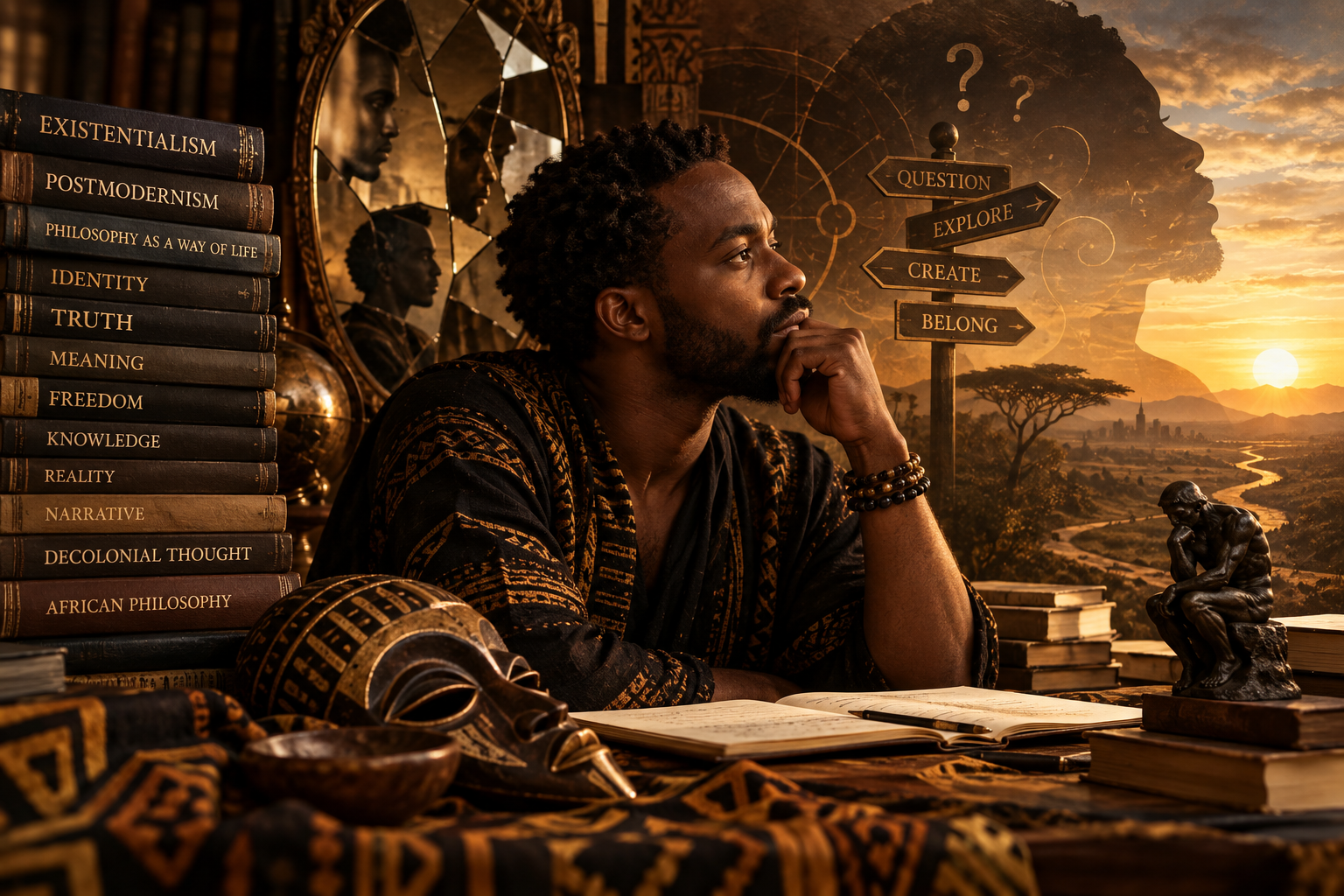
    An editorial exploration of philosophy, identity, truth and questioning

    A Kenyan man I met on TikTok told me I was a postmodernist-existentialist.

    There was only one problem.

    I didn’t know what a postmodernist-existentialist was.

    We had spent hours talking by then. His name is Ekakoro, and our conversations have a habit of beginning somewhere ordinary and wandering somewhere neither of us particularly planned.

    We had talked about language. African history. Christianity. Culture. AI. Hypnosis. Truth. Whether a glass containing exactly half its capacity of water was half full or half empty.

    Then one day he asked me what kind of music I listened to “as a postmodernist thinker.”

    I stopped.

    As a what?

    When I asked him why he thought I was a postmodernist, his answer wasn’t particularly helpful.

    We had spoken at length, he said. I was a “postmodernist-existentialist.”

    So naturally, I asked him for evidence.

    His response, essentially, was that I should look at the philosophies and then look at my own writing.

    Res ipsa loquitur.

    The thing speaks for itself.

    Apparently, I had been writing philosophy without knowing what philosophy I was writing.

    Can we live a philosophy before we know its name?

    Apparently I have been doing philosophy accidentally

    Ekakoro said something during our conversation that stayed with me.

    “Philosophy is a lived experience.”

    His argument was that everything we think, say and do is influenced by some philosophy whether or not we recognise it. Scholars, in his view, didn’t necessarily create these ways of thinking. They identified them and gave them names.

    I wasn’t completely convinced.

    It sounded plausible. But plenty of things sound plausible until you investigate them.

    So I went looking.

    And, annoyingly, Professor Ekakoro—who insists he is not a professor—had stumbled into a rather serious philosophical tradition.

    Existentialism in particular is not simply an abstract system constructed in universities. It places unusual emphasis on concrete, first-person existence: what it actually feels like to find ourselves alive, situated in particular circumstances and required to make something of that life.

    Perhaps more surprisingly, even the category existentialist is something of a retrospective construction.

    Thinkers now routinely grouped under existentialism disagreed enormously. Some were religious. Others weren’t. Some emphasised radical freedom while others placed far greater emphasis on circumstance and limitation. Several major figures now associated with the movement did not comfortably accept the label themselves.

    So perhaps the labels really do sometimes arrive after the thinking.

    That made Ekakoro’s accusation considerably more interesting.

    So what did he recognise in me?

    Existentialism was the easier half.

    One of its recurring ideas is that a human being is not simply born as a completed thing.

    We become.

    Sartre famously expressed this as “existence precedes essence.” The basic idea is that there isn’t necessarily a finished definition of you waiting inside you to be discovered. We participate in creating ourselves through our choices, actions, commitments and interpretations of the circumstances into which we have been thrown.

    That felt familiar.

    I have spent years questioning identities I inherited.

    Names.

    Religion.

    Mental health labels.

    Ideas about success.

    Ideas about spirituality.

    Ideas about what a woman should be.

    Ideas about what a mother should be.

    Ideas about what sanity means.

    Ideas about who gets to tell another human being what their experiences mean.

    Even the name under which I am writing this wasn’t simply handed to me and unquestioningly carried forward.

    Osose is part of something I participated in becoming.

    Perhaps that is one reason Ekakoro heard existentialism in my writing.

    But existentialism also contains a tension I recognise deeply.

    We don’t create ourselves from nothing.

    I did not choose where I was born. I didn’t choose my ancestry. I didn’t choose my childhood. I didn’t choose every event that happened to me. I didn’t invent the culture or language through which I first learned to understand myself.

    Yet none of those things completely determines what I must become.

    Existentialist thinkers wrestled repeatedly with this tension between the circumstances we inherit and what we do with them.

    And suddenly I could see why Ekakoro had reached for the word.

    Postmodernism was harder

    This was where I resisted him.

    Because when I vaguely thought of postmodernism, I associated it with an idea something like:

    There is no objective truth. Everything is interpretation.

    And that doesn’t describe me particularly well.

    I question things constantly.

    But I don’t necessarily question them because I believe nothing is true.

    Quite often, I am questioning precisely because I think something may be true underneath what I have been told.

    That distinction matters to me.

    If somebody tells me that a particular African spiritual figure is evil, I want to know who first described it that way.

    If a historical source calls an indigenous practice primitive, I want to know who wrote the source.

    If somebody tells me that science has proven something, I want to know what the experiment actually demonstrated.

    If somebody makes a spiritual claim, I want to know whether they are describing an experience, an interpretation, a metaphor or an empirically testable claim.

    I am not trying to make truth disappear.
    I am trying to remove the things that may be obscuring it.

    So perhaps Ekakoro was wrong.

    Except postmodernism turned out to be more complicated than the version I had been arguing against.

    Postmodernism doesn’t simply mean “nothing is true”

    The term itself covers a messy collection of thinkers and ideas rather than one unified doctrine.

    One influential formulation comes from Jean-François Lyotard, who characterised the postmodern condition through scepticism toward metanarratives: enormous explanatory stories that claim to organise history, knowledge or human progress into one overarching account.

    Other thinkers commonly associated with postmodernism and post-structuralism examined how language, institutions, history and power influence the categories through which we understand reality.

    Michel Foucault, for example, became interested in genealogy: examining how concepts and systems that can appear natural or inevitable actually developed through particular historical circumstances. Jacques Derrida interrogated assumptions embedded within language and texts. Neither man fits neatly inside a single philosophical box.

    And that was when I became slightly uncomfortable.

    Because I recognised the questions.

    Who decided this?

    When did we begin describing it this way?

    What existed before this category?

    Whose interpretation became authoritative?

    What disappears when one explanation becomes the official explanation?

    Those are questions I ask constantly.

    I had just written an entire investigation after a Kenyan man told me that my name sounded Teso.

    Before that, I had been investigating what happens when ancestral knowledge isn’t transmitted.

    Before that, I had been asking questions about belief, consciousness, identity and the meanings human beings inherit.

    Perhaps Ekakoro had noticed the method before I had noticed it myself.

    But I still don’t think the label completely fits

    And this may be the most important part.

    Because after telling me what philosophy I apparently belonged to, Ekakoro himself refused to assign a philosophical worldview to himself.

    I asked him which worldview prevailed in his thinking.

    He asked:

    Regarding what?

    His argument was that it would be unreliable for him to assign himself a worldview because he might simply choose whichever description made him appear most desirable. Other people, he suggested, could observe him and decide where they thought he belonged.

    That irritated the part of me that wanted a clean answer.

    But perhaps he was demonstrating his own argument.

    People don’t necessarily live inside philosophical boxes.

    We can be sceptical in one context and deeply believing in another.

    We can demand empirical evidence for one claim and trust lived experience for another.

    We can believe objective reality exists while recognising that human beings encounter that reality through subjective perception.

    Which brought us to a glass of water.

    Half full or half empty?

    Ekakoro gave me the familiar thought experiment.

    A glass is filled halfway.

    Is it half full or half empty?

    I refused the premise almost immediately.

    I wanted to know what the water was for.

    If a recipe required exactly that amount of water, I said, the glass was neither deficient nor abundant.

    It contained exactly what was needed.

    He accused me of taking an escapist approach.

    So he removed my escape routes.

    You walk into a room. There is a glass. It is filled halfway. Half full or half empty?

    I still wanted context.

    If I had been walking through a desert without water and suddenly discovered that glass, I might experience it as astonishing abundance.

    If I needed enough water to shower and there was no other water available, the same quantity could feel radically insufficient.

    Ekakoro then pointed out that those internal and external circumstances were precisely what shape perception.

    And suddenly we were no longer discussing optimism.

    We were discussing reality.

    The quantity of water is measurable.

    150 millilitres can simply be 150 millilitres.

    But enough, scarce, plenty, fortunate, disappointing and valuable are not properties floating inside the water.

    They emerge through a relationship between the water, the environment, the observer and what the observer needs.

    Then we disagreed again.

    Ekakoro thought a very thirsty person with no other available water might be more inclined to see the glass as half empty.

    I thought the opposite was equally plausible.

    After hours without water, I might look at that glass and think:

    Water.

    Two people can therefore encounter the same objective quantity under remarkably similar circumstances and still experience its meaning differently.

    The water doesn’t have to become unreal for interpretation to become important.

    That distinction may explain my discomfort with the postmodernist label better than anything else.

    I don’t want to choose between reality and interpretation

    There seems to be a temptation in intellectual arguments to force us toward one side.

    Either there is objective reality and subjective interpretation is merely distortion.

    Or everything is interpretation and claims to objectivity are themselves constructions.

    I don’t find either position particularly satisfying.

    Perhaps there is a world that exists independently of me.

    And perhaps I never encounter that world without also being me.

    I bring a body.

    A history.

    Language.

    Expectations.

    Fear.

    Memory.

    Culture.

    Desire.

    Previous experiences.

    And questions.

    That doesn’t necessarily make reality subjective. It makes my encounter with reality situated.

    Interestingly, existentialism itself strongly emphasises this situated quality of human experience. Its thinkers generally reject the fantasy that we can understand human existence entirely from some detached “view from nowhere.” We encounter existence from inside it.

    And the intellectual traditions that followed existentialism—including post-structuralism—pushed some of those questions further, examining how history, language and social structures shape the subjects doing the interpreting.

    Perhaps that is why Ekakoro used both words.

    Not postmodernist.

    Not existentialist.

    Postmodernist-existentialist.

    Perhaps philosophies overlap because people do

    There is something strange about discovering a thinker from another century articulating something you thought you had arrived at yourself.

    Did I independently discover existentialism?

    Obviously not in any meaningful historical sense.

    Millions of people have encountered these ideas before me.

    And the language through which I think has itself been shaped by centuries of ideas I may have absorbed indirectly without ever reading their originators.

    Perhaps I encountered existentialist ideas through novels.

    Therapy.

    Spiritual writing.

    Films.

    Conversations.

    Culture.

    Perhaps ideas travelled into my thinking without their labels attached.

    Or perhaps human beings repeatedly arrive at similar questions because we repeatedly encounter the same fundamental problem:

    We wake up inside lives we did not design and have to decide what to do with them.

    Philosophers then become unusually persistent people who refuse to stop asking what that means.

    Did philosophers invent philosophy?

    I don’t think I would now state Ekakoro’s proposition quite as strongly as he did.

    Scholars don’t merely walk around discovering fully formed philosophies lying inside ordinary human behaviour and attaching labels to them.

    Philosophers construct arguments.

    They create concepts.

    They disagree.

    They refine distinctions.

    They inherit earlier ideas and transform them.

    Sometimes an individual thinker genuinely changes the intellectual possibilities available to everyone who comes afterwards.

    But I think Ekakoro was pointing toward something important.

    Philosophy doesn’t begin when somebody opens a philosophy book.

    A person wondering whether they are obligated to obey the religion of their parents is already confronting questions about authority, freedom and identity.

    Someone deciding whether suffering has meaning is doing something philosophers have spent millennia doing.

    Someone asking whether the person they became was chosen or conditioned has wandered into debates about freedom and determinism.

    Someone asking whether something can be true even if nobody believes it exists has entered epistemology and metaphysics whether or not they know either word.

    The academic discipline gives us histories, concepts, distinctions and conversations extending across generations.

    But the questions themselves belong to human beings.

    And perhaps the labels should come last

    There is something wonderfully ironic about this investigation.

    I began by asking whether I was really a postmodernist-existentialist.

    I ended by becoming less interested in knowing.

    Perhaps philosophical labels are maps.

    Maps are useful.

    They show us where ideas have travelled before.

    They allow us to recognise intellectual neighbours we didn’t know we had.

    They give us language for distinctions we were struggling to articulate.

    But nobody lives inside a map.

    And I don’t particularly want to start filtering my thoughts through a new question:

    What would an existentialist think about this?

    That would reverse the entire process.

    I would rather encounter the question first.

    Think.

    Get something wrong.

    Change my mind.

    Contradict myself.

    Follow the contradiction.

    And only afterwards discover whether somebody else has been standing somewhere nearby for the last two thousand years.

    Maybe Ekakoro was right.

    Maybe philosophy was already present in my writing before I knew what anybody would call it.

    But perhaps the discovery isn’t:

    I am a postmodernist-existentialist.

    Perhaps it is something much more interesting.

    There are names for some of the questions I have been asking.

    And now I have more people to ask them with.


    Sources & further reading

    OBSERVE · QUESTION · EXPLORE · CREATE
  • A Kenyan Man Told Me My Name Sounded Teso. So I Started Investigating.

    A Kenyan Man Told Me My Name Sounded Teso. So I Started Investigating.

    BELIEF · ARCHIVE 003

    A Kenyan Man Told Me My Name Sounded Teso. So I Started Investigating.

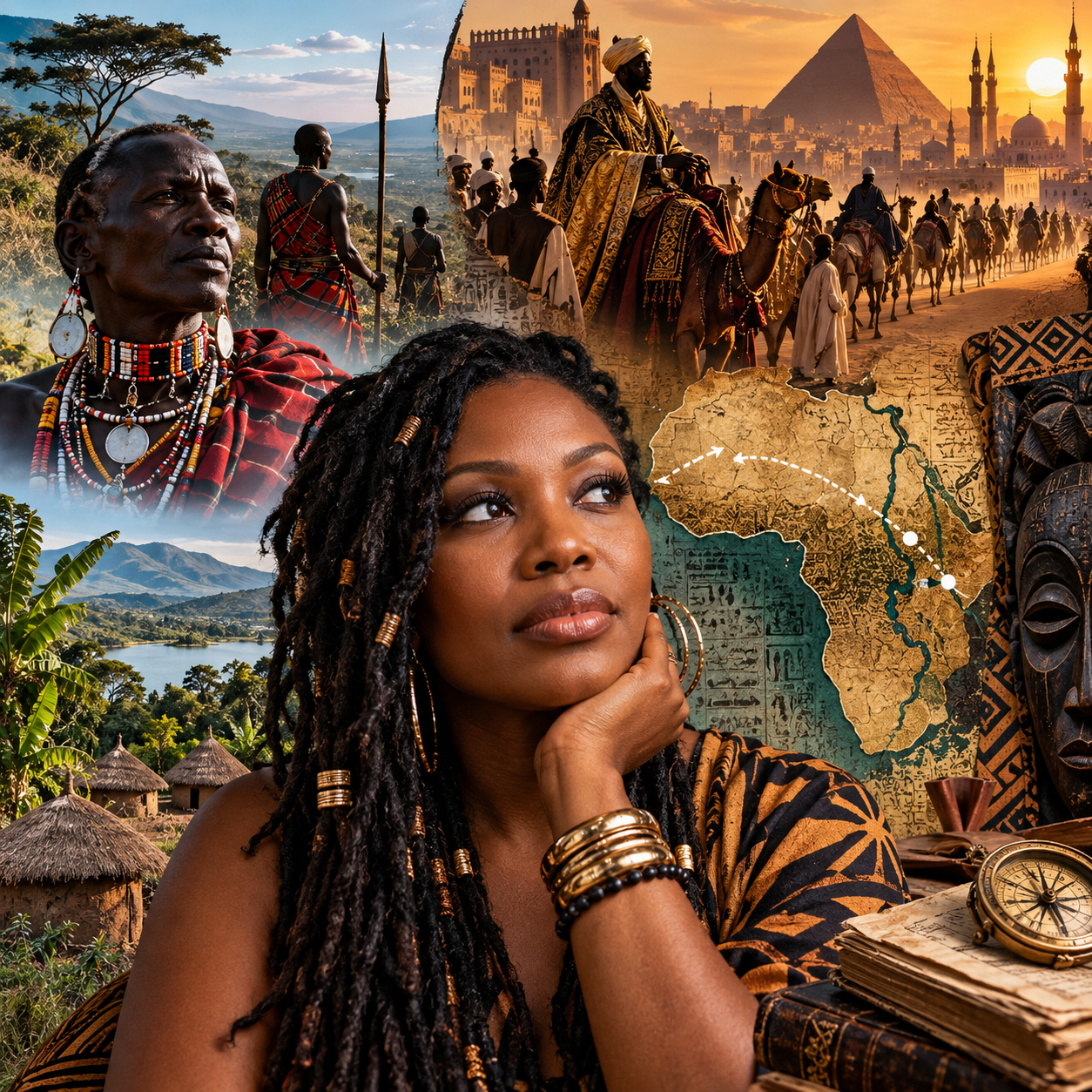
    A conversation about a name became an investigation into Ateso, migration, oral history and the connections we think we recognise across Africa.

    An illustrated exploration of Iteso identity, African migration, language and ancestry

    A Kenyan man came into my TikTok Live and told me my name sounded Teso.

    I had never heard of the Teso.

    A few hours later, I had pages of notes.

    His name was Ekakoro. He was from Kenya, he was Iteso, and somewhere in what began as an ordinary TikTok conversation, he started teaching me words in Ateso, telling me about his culture and pointing out similarities he believed existed between his language and words and names I recognised from other parts of Africa.

    Then he told me his theory about why.

    It involved Mansa Musa, medieval Mali, Egypt, Sudan, the Nile and generations of African migration.

    I didn’t know whether he was right.

    But I knew I wanted to investigate.

    That is, after all, what I seem to do.

    I follow questions wherever they lead.

    Why did my name sound Teso?

    My name wasn’t given to me by my parents.

    I chose African names later in my life as part of my own relationship with identity, ancestry and reconnection. My parents were Caribbean — Jamaican and Trinidadian — and like many descendants of Africans in the Caribbean, I know that Africa is part of my ancestry without possessing a neat map showing precisely where every branch of that ancestry began.

    Oya is a Yoruba name. So when a Kenyan man from an ethnic group I knew almost nothing about heard my name and apparently recognised something familiar in it, I was curious.

    Ekakoro told me that many names he encounters from Ghana and Nigeria sound surprisingly familiar to him as an Ateso speaker.

    That doesn’t establish a connection.

    Languages contain coincidences. Similar sounds can develop independently. Words can travel between neighbouring populations. Languages borrow from one another. And human beings are exceptionally good at noticing patterns once we begin looking for them.

    But a resemblance doesn’t have to prove something to make it interesting.

    It can simply give us a question.

    Why did these sounds seem familiar to him?

    First, who are the Iteso?

    The Iteso live primarily in Uganda and Kenya, and their language is Ateso.

    This much was relatively straightforward to establish.

    Academic linguistic research classifies Ateso within the Teso-Turkana subgroup of Eastern Nilotic languages. It is related to languages including Turkana and Ngakarimojong, and its linguistic history belongs to the much broader history of Nilotic-speaking populations in eastern and northeastern Africa.

    That mattered because one part of what Ekakoro had told me was immediately supported: the Iteso really do belong to a linguistic family whose history extends far beyond the modern borders of Kenya and Uganda.

    And borders matter here.

    When we talk about African peoples today, it is very easy to imagine the modern countries first: Kenyan, Ugandan, Nigerian, Ghanaian, Sudanese.

    But languages, families, cultures and migrations are considerably older than many of those borders.

    The map came later. Languages, families, cultures and migrations are older than many of the borders through which we now describe them.

    Then he started teaching me Ateso

    This was probably the point at which the conversation became irresistible to me.

    Ekakoro started explaining how words worked.

    One of the words he taught me was aberu: woman.

    When I later went looking, there it was.

    Ateso linguistic material independently records aberu as a word for woman, and academic work on the language confirmed something more interesting about what he had been trying to explain to me.

    Those vowels at the beginnings of Ateso nouns can matter.

    Ateso uses noun prefixes in its system of grammatical gender and noun classification. Linguistic descriptions document distinctions involving initial vowels, including masculine and feminine marking, rather than those vowels simply being meaningless sounds attached to otherwise identical words.

    Ekakoro had given me examples of changing those initial vowels to communicate things such as gender, size or abundance.

    The underlying grammatical phenomenon was real.

    But the precise examples became more complicated when I tried to verify every one of them.

    And I liked that.

    Because there is a difference between saying:

    This is what an Ateso man taught me about his language.

    and saying:

    This is linguistically established to work exactly as I have described it.

    Those aren’t necessarily the same claim.

    Some things I could verify. Some I couldn’t. Some appeared considerably more complicated once I began reading linguistic research.

    Instead of ruining the investigation, that made it more interesting.

    Even his name gave me another clue

    Ekakoro had told me that his Teso name referred to a rooster.

    For him, the rooster carried associations of bravery and leadership.

    At first, I simply wrote it down as something he had told me about his name.

    Then I went looking.

    And Ateso material contains closely related forms for cock or rooster.

    Suddenly another small piece of our conversation had acquired independent support.

    Again, this proves nothing about some enormous forgotten migration across Africa.

    But this was becoming my favourite part of the investigation.

    Ekakoro would tell me something.

    I would write it down.

    Then I would go looking.

    Sometimes I found exactly what I expected.

    Sometimes I found something adjacent to it.

    Sometimes I found something that complicated it completely.

    Then came Mansa Musa

    Eventually Ekakoro gave me his larger explanation.

    His theory was that some of the apparent similarities he notices between Ateso and West African names or words might be remnants of historical African migrations.

    And this is where Mansa Musa entered the conversation.

    Mansa Musa was the fourteenth-century ruler of the Mali Empire whose pilgrimage to Mecca has become one of the most famous journeys in African history.

    The pilgrimage itself is not legend.

    Mansa Musa travelled through Cairo in 1324 on his way to Mecca, accompanied by a substantial entourage. Contemporary and later accounts differ about its precise size, but his extraordinary procession and expenditure in Cairo were recorded by medieval writers. Modern historical scholarship dates the pilgrimage to 1324–1325.

    Ekakoro wondered whether people associated with movements such as this could have remained in northeastern Africa, mixed with other African populations and eventually contributed to migrations farther along the Nile and into eastern Africa.

    It is a fascinating story.

    But fascinating stories and established history are not the same thing.

    This is where the theory begins to struggle

    I went looking for the bridge.

    Mali.

    Mansa Musa.

    Egypt.

    Movement along the Nile.

    Sudan.

    The ancestors of the Iteso.

    So far, I haven’t found credible historical or linguistic evidence establishing that chain.

    What I found instead was a considerably older and more complicated story.

    Ateso is not classified as an offshoot of a medieval West African language. It belongs firmly within Eastern Nilotic and specifically the Teso-Turkana group. Linguistic research reconstructing these relationships places them within a much deeper East and Northeast African linguistic history.

    Recent archaeological research is particularly interesting here. Work examining population movements in eastern Africa discusses north-to-south expansion associated with Eastern Nilotic populations and evidence of Sudan-related ancestry in ancient East African populations dating to long before Mansa Musa’s fourteenth-century pilgrimage.

    So Ekakoro may have been pointing toward something real in a broad sense — historical movement between northeastern and eastern Africa — while the particular Mansa Musa explanation may be attempting to connect events that belong to very different historical processes.

    That distinction matters.

    There is a huge difference between saying:

    African populations moved over enormous distances, mixed, separated and formed new communities.

    and saying:

    These particular people descended from members of Mansa Musa’s entourage.

    The first is unremarkable as a general feature of human history.

    The second requires evidence.

    And I haven’t found it.

    But then what about the similarities?

    This is where I refuse to replace one premature conclusion with another.

    If two words in distant African languages sound similar, there are several possibilities.

    They could ultimately share an ancient linguistic ancestor.

    One language could have borrowed something from another.

    Populations could have interacted at some point.

    Or two words could simply sound alike by chance.

    Comparative linguistics doesn’t establish relationships by finding one or two words that resemble each other. Researchers look for systematic patterns across substantial bodies of vocabulary, grammar and sound change.

    So hearing an Ateso word that sounds like something from Ghana or Nigeria isn’t enough to redraw African history.

    But neither do I think the appropriate response is: That’s a coincidence. Next question.

    I want to know which language the supposedly similar West African word comes from.

    I want to know how old both forms are.

    I want to know whether there are ten similarities or one.

    I want to know whether the consonants change systematically.

    I want to know what historical movements are independently supported.

    In other words, I don’t want the resemblance to become evidence before it has earned that status.

    But I also don’t want curiosity killed simply because evidence hasn’t arrived yet.

    There is another kind of evidence too

    Something else happened during that conversation.

    Ekakoro wasn’t giving me an academic lecture.

    He was telling me what he had been told.

    What he remembered.

    How his people understood certain practices.

    What words meant to him.

    Where he believed his ancestors had travelled.

    And that raised another question for me.

    What do we do with oral knowledge?

    Oral history is not automatically factual simply because it has been transmitted across generations.

    But written history isn’t magically free from perspective either.

    Colonial archives were produced by particular people for particular purposes. Missionaries documented some African traditions while actively attempting to transform others. Anthropologists interpreted cultures through their own frameworks. Indigenous histories sometimes survived precisely because people continued telling stories that were never written down.

    So perhaps the task isn’t to choose between:

    The academic source is true.

    and

    The elder’s story is true.

    Perhaps the more interesting work begins when we place different forms of knowledge beside one another and ask what each can actually establish.

    Africa contains histories we may no longer know how to read

    That thought stayed with me after the Live ended.

    A word can survive after its history has been forgotten.

    A ritual can survive after its explanation changes.

    A name can cross generations after nobody remembers why the first person carried it.

    A migration can remain inside an origin story long after dates and locations become blurred.

    And sometimes entirely unrelated things can resemble one another so strongly that human beings construct a connection that never existed.

    All of these things can be true.

    Which makes reconstructing African history particularly fascinating.

    The continent has experienced migrations, empires, trade, intermarriage, religious conversion, colonial borders, language suppression and enormous cultural change.

    Some connections will be recoverable.

    Some will turn out to be imagined.

    Some may remain permanently uncertain.

    I still don’t know why my name sounded Teso

    And perhaps that’s the most appropriate ending.

    I started with a remarkably simple moment.

    A Kenyan man heard my name and said:

    That sounds like us.

    From there came Ateso grammar, Nilotic migrations, Mansa Musa, medieval Cairo, oral history, comparative linguistics and questions about what happens to human memory across generations.

    I haven’t discovered that my name is secretly Teso.

    I haven’t discovered that the Iteso descended from Mansa Musa’s entourage.

    I haven’t uncovered a forgotten migration connecting Nigeria, Ghana and Kenya.

    What I discovered was a question.

    And perhaps that is enough.

    Because curiosity doesn’t require us to believe every explanation we encounter.

    It requires almost the opposite.

    To listen seriously.

    To investigate carefully.

    To be willing to discover that something we hoped was true isn’t.

    To be equally willing to discover that something we dismissed contains a fragment worth following.

    A similarity is not proof of a connection.

    But sometimes a similarity is enough to give you a question worth following.

    And I intend to follow this one a little further.


    OBSERVE · QUESTION · EXPLORE · CREATE
  • What Do We Inherit When Our Inheritance Is Kept Secret?

    What Do We Inherit When Our Inheritance Is Kept Secret?

    CONSCIOUSNESS · ARCHIVE 002

    What Do We Inherit When Our Inheritance Is Kept Secret?

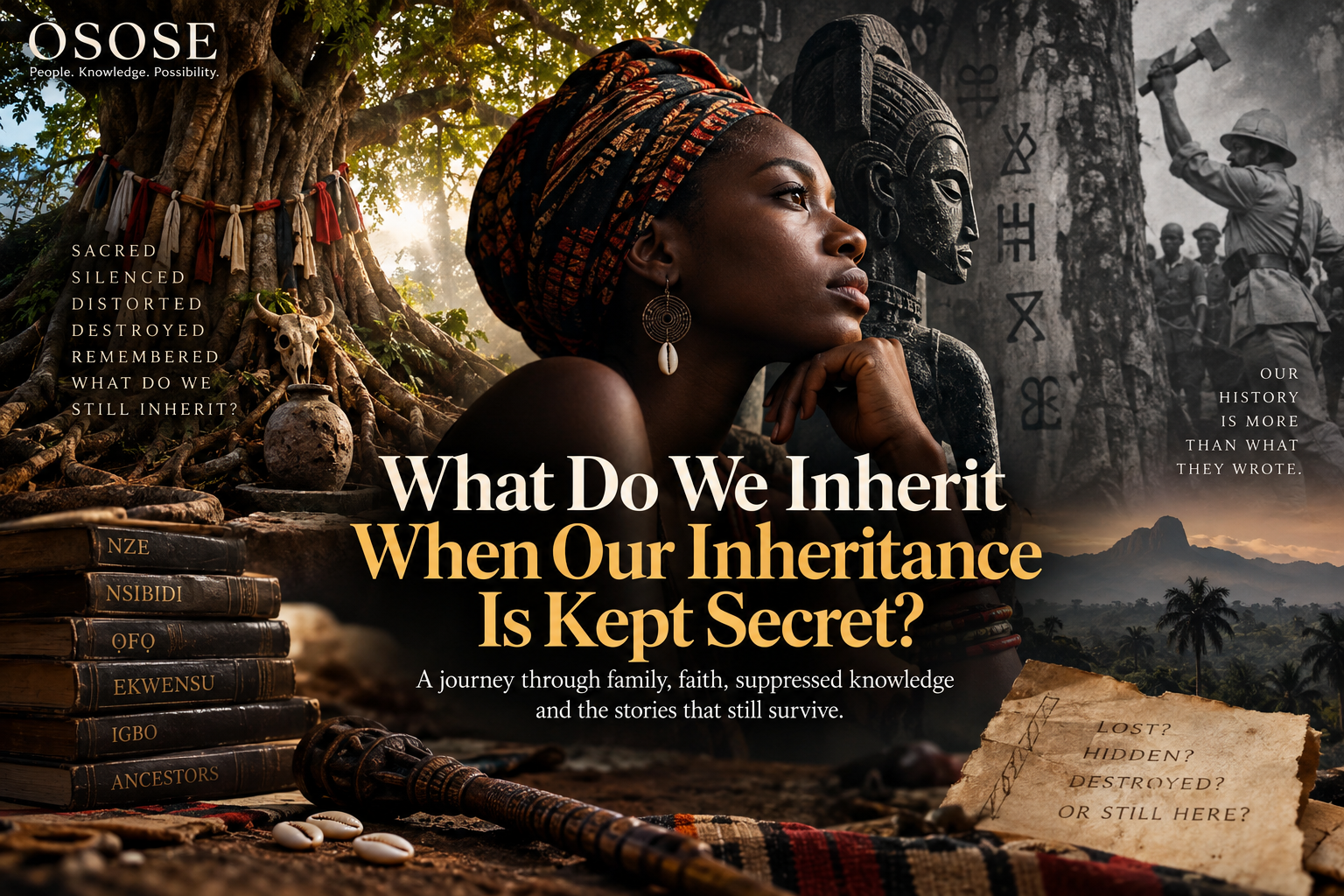
    An investigation into ancestral knowledge, interrupted transmission, Christianity, secrecy and what it means to inherit a past you were never taught.

    Ancestral knowledge, cultural memory and interrupted inheritance in an Igbo-inspired archival collage

    I met Patrick Igweh on a TikTok Live.

    I hadn’t gone there looking for an investigation into ancestral knowledge. I wasn’t researching Igbo religion or colonial history. We were simply talking, and as conversations sometimes do, this one kept opening doors.

    Patrick is Nigerian and Igbo. At some point, he told me that his great-grandfather had been an Nze—a man he described as a custodian of law, someone whose position carried not only social authority but spiritual backing.

    I later discovered that this description wasn’t entirely unfamiliar to the historical record. Nze/Ozo institutions varied considerably between Igbo communities, but title-holders could occupy positions carrying religious, political, ethical and social significance. That doesn’t tell me precisely what Patrick’s great-grandfather did. It does tell me that the world Patrick was describing had institutional roots deeper than a family story.

    And then he told me something that stayed with me.

    None of the children continued it. The line ended.

    At first, I heard this as a story about something being lost. But the longer we spoke, the less certain I became that lost was the right word.

    Because there are many ways for knowledge to disappear. It can be forgotten. It can be destroyed. It can be deliberately abandoned. It can become incompatible with a new religion. It can survive in one branch of a family while disappearing from another.

    And sometimes it doesn’t disappear at all.

    Sometimes people simply stop telling you.

    When nobody tells the children

    Patrick grew up in a Christian family. His great-grandfather belonged to a world that Patrick did not inherit in the same way.

    When I asked about that world, his attitude was initially almost startlingly matter-of-fact. His great-grandfather had lived his life. His father had lived his. Patrick was living his own.

    There was something in that I understood. We talk about ancestry as though inheritance automatically creates obligation. But why should someone be required to continue a spiritual practice simply because their ancestors practised it?

    Perhaps refusing an inheritance is itself an expression of sovereignty.

    Yet later in our conversation, Patrick described Igbo identity very differently. He spoke about family responsibility—about the person who travels abroad carrying brothers, sisters, nephews and nieces with them. The individual, in his description, does not exist entirely alone.

    Where does the individual end and the ancestors begin?

    I don’t think the answer is that we owe our ancestors obedience. But perhaps there is a difference between choosing not to carry something and never being told what there was to carry.

    Lost is not the same as hidden

    Patrick kept returning to the idea that people know more than they admit. At one point he told me, you have to go deep to understand.

    Then he told me a story from his own family.

    What follows is Patrick’s account as he told it to me. I have not independently verified the events.

    There had been a tree associated with older spiritual practices. During a Christian prayer session, a priest identified the tree as evil. Patrick’s uncle was there, but according to Patrick, his uncle behaved as though he didn’t know what the tree was or what had previously happened there.

    Later, Patrick learned a very different history of the tree. He told me that it had once been a place where sacrifices were made. Animals had been sacrificed there and, according to the account passed down to him, human beings had also been sacrificed there.

    The sacrifices had stopped.

    Patrick’s story then became stranger. He said the spirit associated with the tree became angry because it was no longer receiving sacrifices. Somehow, the tree was moved from its original location and appeared in another village. A baby subsequently died there. The people in that village interpreted the death as connected to the tree and the spirit associated with it. They investigated where the tree had come from, traced it back to Patrick’s community and returned it. Eventually, according to Patrick, the tree was removed again and dumped beside a highway.

    It is an extraordinary story. And there are several completely different claims contained inside it: the possible history of the physical tree and where it was moved; the oral history that animal and human sacrifices had once taken place there; the Christian priest’s interpretation of the tree as evil; the older spiritual interpretation that the tree was associated with a spirit requiring sacrifice; the baby’s death; and the causal interpretation that the spirit caused that death because the sacrifices had stopped.

    I don’t know which of those events could be independently established. A baby dying after the arrival of a tree does not, by itself, establish that a spirit killed the child. Equally, dismissing the entire account as superstition would tell me very little about what the tree meant to the people who lived with it.

    But strangely, the supernatural part wasn’t what interested me most.

    It was Patrick’s uncle. Why pretend not to know?

    Here was a Christian priest identifying something as evil while a member of the family, according to Patrick, possessed an older understanding of exactly what that thing was—and remained silent.

    Perhaps somebody remembered. Perhaps they had rejected it. Perhaps Christianity had made acknowledging that knowledge uncomfortable. Perhaps there were things the older generation simply did not want to explain to the younger one. Or perhaps Patrick’s interpretation of his uncle’s silence is itself part of a story reconstructed later.

    I cannot know.

    What looks like forgetting from the outside but is actually silence?

    There is a difference between knowledge being lost, forgotten, rejected, concealed and deliberately not transmitted. Those categories can look identical several generations later.

    The grandchild simply doesn’t know.

    Some knowledge was never meant for everybody

    It would be easy to construct a familiar story: Africans possessed ancestral knowledge; Europeans arrived; Christianity displaced indigenous traditions; the knowledge disappeared.

    There is truth inside parts of that history. But the neatness of the story bothered me. Because when I began researching the traditions Patrick had mentioned, I encountered something that complicated it.

    Some knowledge was already restricted.

    Nsibidi, for example—the graphic communication system Patrick mentioned during our conversation—was used historically across communities in southeastern Nigeria and the Cross River region. Some signs could circulate more publicly while other bodies of signs were associated with initiated societies and restricted knowledge.

    Secrecy, therefore, cannot simply be interpreted as evidence of colonial erasure. Sometimes secrecy was part of the knowledge system itself.

    If knowledge belongs only to particular initiates, elders, title-holders or ritual specialists, what happens when the chain of initiation breaks?

    The symbols may remain. The objects may remain. Someone may even remember fragments of what they mean. But access to the system that made those fragments intelligible can disappear.

    There is a difference between losing knowledge and losing access to knowledge.

    Truth you can hold in your hand

    One of the things Patrick described to me was ọfọ. He told me it represented truth.

    In his account, spiritual authority wasn’t simply power. A person had to be morally capable of carrying it. Someone whose hands were metaphorically stained could not simply pick up such authority and use it without consequence.

    When I later looked for scholarship on ọfọ, Patrick’s description suddenly became much less unfamiliar. Research describes it as a material and mystical symbol connected with truth, purity, justice and authority, and connects ọfọ-na-ogu with innocence, uprightness and moral purity.

    That doesn’t establish Patrick’s supernatural claim about what happens to someone who uses it wrongly. But the moral architecture he described—the idea that legitimate authority and moral standing belong together—is documented.

    And that made another phrase Patrick used stay with me.

    He spoke about a time “when the rituals got soured.”

    His interpretation was that practices originally connected with protection, truth and obligation became corrupted by the desire for money and power.

    I don’t yet know how much of that chronology can be historically demonstrated. Oral histories are not automatically factual simply because they are ancestral, just as colonial records are not automatically neutral simply because somebody wrote them down.

    What happens when a spiritual technology survives but the ethical system that governed it doesn’t?

    What survives attempted destruction?

    Patrick had told me that Europeans had “taken” or destroyed some of the older oracles. That claim sounded enormous until I encountered the history of Ibinukpabi, the Aro oracle British sources called the Long Juju.

    A British military expedition destroyed the shrine in 1902. Historical research records that it was secretly restored, destroyed again and restored again, while colonial authorities curtailed powers exercised by important shrines that conflicted with the new colonial government.

    This doesn’t turn Patrick’s broad statement into a description of every oracle or every Igbo community. But it gives us a documented example of deliberate institutional disruption—and of people refusing to let an institution simply disappear.

    What do we call knowledge that survives its own attempted destruction?

    When a warrior becomes the Devil

    Then Patrick told me about Ekwensu.

    Patrick explained that when Christians spoke about the Devil in Igbo, they used the name Ekwensu. But the Ekwensu he had learned about from older Igbo tradition was not simply another name for the Christian Devil. He described Ekwensu as a powerful warrior figure associated with Igbo strength and resistance. That distinction caught my attention: had an existing Igbo spiritual figure been made to carry the meaning of a very different Christian being? When I went looking for the history behind what Patrick had told me, I discovered that the question had a documented history of its own.

    Nigerian scholarship describes Ekwensu as a heroic Igbo deity of war and patron spirit of ancient Igbo warriors, while more recent ethnographic research describes a divinity associated with warfare and fertility whose characteristics differ substantially from the Christian Satan.

    That means something important really did happen through translation.

    A name remained. But what the name pointed to changed.

    Patrick’s story, however, contained another layer. He had been told that Ekwensu was himself a powerful human warrior who fought Western conquerors, and that his name was subsequently demonised because of his resistance.

    That is where the written evidence becomes much thinner.

    I can find evidence for Ekwensu as a war divinity. I can find evidence for warriors invoking Ekwensu. I can find scholarship challenging the later equation of Ekwensu with Satan. What I cannot yet establish is that Ekwensu began as a historical human warrior whose identity was deliberately erased by Europeans.

    And perhaps the space between those versions is itself part of the inheritance.

    How does a war god become the Devil? How does a spirit associated with warriors become remembered as a warrior? And after generations of translation, conversion and oral retelling, how do we know which transformation happened when?

    I don’t want to solve that uncertainty by simply choosing whichever version appeals to me more. If I am interested in recovering knowledge that may have been distorted, I cannot respond by accepting every counter-story simply because it feels more restorative.

    Otherwise I have only exchanged one unquestioned narrative for another.

    What happens when a worldview disappears?

    An object can survive longer than its meaning. A word can survive after the concept it once carried has changed. A ritual can continue after people have forgotten why particular movements are performed. A sacred object can enter a museum and become art. A deity can become a devil. A family can remember that a great-grandfather held an important title without remembering what he knew.

    And a descendant can eventually type the remaining fragments into Google.

    Patrick himself told me that some of what he now knows about older traditions did not come through his own family. Someone else told him things they had learned through their grandparents. Patrick then searched online.

    Grandparent → grandchild → stranger → Google → Patrick → TikTok Live → me → this page.

    Perhaps that is also transmission. Not the transmission the original holders would have recognised, but transmission nonetheless.

    And it makes me wonder how many fragments of human knowledge are currently travelling through pathways like this.

    Not preserved intact. Not completely lost. Just wandering.

    The archive is not neutral

    At one point during our conversation, I became suspicious of Google itself.

    If I search for African traditions using a search engine built within a Western technological system, whose version of Africa am I actually retrieving?

    But that question also needs complication. The problem isn’t simply that “Western people wrote the history.” The deeper problem is what becomes searchable.

    Who wrote things down? Who had access to printing? Which manuscripts survived? Which languages were digitised? Who catalogued museum collections? Which oral traditions were recorded before their holders died? Which accounts were written by missionaries describing practices they already considered pagan? Which were written by colonial administrators trying to govern people they didn’t fully understand? Which modern accounts are descendants reconstructing from fragments?

    And what happens to knowledge that never entered an archive at all?

    Google can retrieve a colonial officer’s description written a century ago. It cannot retrieve the conversation a grandmother never had with her granddaughter.

    That absence matters. But absence is not evidence that whatever we imagine was there must have existed either.

    The archive can be incomplete without our imagination automatically becoming the missing page.

    Recovery is not restoration

    There is another danger in conversations about ancestral knowledge.

    Romanticism.

    Old does not automatically mean wise. Indigenous does not automatically mean good. Ancestral does not automatically mean something I am morally required to reproduce.

    Patrick himself talked about practices he would not want to continue. We discussed sacrifice, spiritual power and traditions that later generations may have rejected for reasons entirely their own.

    Remembering something is not the same as endorsing it.

    I can understand why an ancestor performed a ritual without performing it myself. Someone can learn the name of a deity without worshipping that deity. A Christian can investigate the religion of their ancestors without ceasing to be Christian. A descendant can decide that an ancestral practice was cruel. Another can decide that something precious was discarded unnecessarily.

    Both decisions become more meaningful when they are made with knowledge.

    Perhaps recovery is not about returning to the past. Perhaps it is about recovering enough of the past to choose our relationship with it consciously.

    What did I inherit without knowing it?

    And somewhere during this conversation, Patrick’s story stopped being entirely about Patrick.

    I chose the name Oya Omore as part of my own process of identity and sovereignty.

    Now I find myself researching what Omore actually means.

    Not what a baby-name website tells me it means. Not what I would like it to mean. I want to follow the word backwards—through dictionaries, languages, spellings, missing tonal marks, geography and history—and see what survives.

    That investigation has already produced another cupboard full of questions.

    And perhaps that is why Patrick’s story affected me. I am also trying to understand what I inherited.

    Some of that inheritance is biological. Some cultural. Some spiritual. Some imposed. Some chosen. Some may be imagined. And some may be impossible to recover.

    Self-discovery, then, is not simply asking Who am I?

    Who was I told I was? Who were the people before me? Who named them? What did they stop saying? What did somebody else rename? What survived anyway?

    And perhaps most importantly:

    If I recover something that was not given to me, what do I do with it now?

    I don’t think inheritance demands obedience. But I am beginning to think there is a particular kind of loss in being unable to choose because nobody ever told you what the choices were.

    Patrick Igweh’s great-grandfather had knowledge Patrick did not inherit.

    Yet generations later, sitting on opposite sides of the world, two strangers began talking about it on TikTok.

    And now I am looking for it too.

    Maybe some knowledge doesn’t disappear.
    Maybe it just waits for somebody to ask the next question.


    Sources & further reading

    OBSERVE · QUESTION · EXPLORE · CREATE

  • What Happens to Creativity When Making Becomes Easy?

    What Happens to Creativity When Making Becomes Easy?

    CREATIVITY · ARCHIVE 001

    What Happens to Creativity When Making Becomes Easy?

    AI and creativity, abundance, attention and what remains human.

    Osose Omore in an earthy creative study surrounded by books, plants, symbols and writing materials

    There are creatives who have spent years, sometimes decades, developing their craft who look at artificial intelligence and feel threatened by the apparent ease of making things now.

    I understand why.

    If you spent twenty years learning how to illustrate, compose music, edit films or construct beautiful sentences, and suddenly someone who has never developed those skills can produce something technically impressive in seconds, it can feel as though something has been taken from you.

    But I wonder whether that way of looking at creativity begins with the assumption that creativity is scarce.

    I have never experienced it that way.

    Before I begin certain pieces of work, I open what I call the Codex and say:

    I open the Codex again. Spirit, guide my words with clarity. Let my work sustain the living field, and also sustain me, as spirit is eternal, abundant and overflowing.

    You don’t have to share my understanding of spirit for the idea underneath those words to make sense.

    I think of creativity like water.

    If you lived beside an ocean, you wouldn’t become frightened because somebody else had discovered water. You wouldn’t stand at the shoreline worrying that another person drinking from it meant there would be less ocean available to you.

    Water can appear scarce. Human circumstances can make access to it scarce. But the ocean itself gives us a different image: something enormous, moving and continually available.

    That is much closer to how creativity feels to me.

    Creativity was never scarce

    AI has made certain forms of creative execution extraordinarily easy.

    I can have an idea and produce an image without spending ten years learning to paint. I can explore a piece of music without mastering every instrument. I can experiment with forms of writing that previously would have required skills I don’t possess.

    That doesn’t make me feel as though creativity has become less valuable.

    It makes me wonder what becomes possible when more people are given access to the tools of creation.

    Because giving everybody the same tool does not give everybody the same imagination.

    Give two people the same camera and they will photograph different things.

    Give two people the same AI and they will ask it different questions.

    Give two people the same piece of music and they may not even hear the same song.

    We notice differently.

    One person notices rhythm. Another notices a lyric. Someone else hears the bass. Someone remembers a person they loved twenty years ago.

    We are never simply receiving the thing in front of us. We are meeting it with everything we already are.

    Perhaps that is where creativity really begins.

    My brother never liked my poetry

    I’ve written poetry for most of my life, and when I was younger I wanted my brother to enjoy my writing.

    He didn’t.

    It used to frustrate me because I thought he had a brilliant mind. I wanted so badly to write something that would entertain that mind.

    But he simply didn’t love poetry.

    Interestingly, that rejection became creatively useful. It made me wonder whether I could write differently. Could I approach an idea another way? Could I find a form of expression that reached him?

    The problem wasn’t necessarily that my poetry wasn’t beautiful.

    Beauty wasn’t enough.

    There had to be a meeting between what I had made and the person encountering it.

    Music works like this for me too. I love jazz and neo-soul. I enjoy elements of rock, although I wouldn’t ordinarily describe myself as someone who loves heavy rock. But somebody could take heavy rock, combine it with something unexpected and create precisely the piece that makes me fall in love with it.

    I listen to peyote music. I listen to icaros. I listen across traditions and genres that don’t necessarily belong together neatly on somebody else’s playlist.

    Taste is strange like that.

    And if our tastes are different, our creations will be different too.

    Creativity happens twice

    I’m beginning to think creativity happens at least twice.

    It happens when the creator encounters the world and notices something.

    And it happens again when another person encounters what they made.

    Neither encounter is neutral.

    Even if everybody were looking at exactly the same thing, we wouldn’t necessarily be experiencing the same thing.

    Someone notices a sound. Someone notices a colour. Someone notices the expression on a person’s face that everybody else missed. Someone asks a question nobody else thought was important enough to ask.

    That difference in attention matters.

    Perhaps, then, when machines make execution extraordinarily easy, the value moves somewhere else.

    Noticing becomes more important. Taste becomes more important. Selection becomes more important. Intention becomes more important.

    The question changes from Can I make this? to Why am I making this?

    But abundance has a shadow

    There is a reasonable counterargument to all of this.

    While researching AI and creativity, I came across research suggesting that generative AI can increase the novelty of an individual’s creative work while simultaneously making the output of a group less diverse when people rely on similar AI-generated ideas.

    That matters.

    If millions of us ask similar systems similar questions, accept their first answers and reproduce the patterns they give us, easier creation could produce more things without producing more diversity.

    So I don’t think access to AI automatically makes us more creative.

    Abundant tools do not guarantee abundant imagination.

    The difference may lie in what we do with them.

    Do I ask the machine to think instead of me?

    Or do I allow what it produces to provoke another thought?

    Do I accept the first answer?

    Or does the answer make me notice another question?

    My experience of AI has increasingly become the second.

    I express something. The machine reflects something back. I disagree with part of it. That disagreement reveals another thought. I follow that thought somewhere I wasn’t expecting to go.

    The creation isn’t simply the output.

    Sometimes the creation is the conversation that changes the person creating.

    What if AI could write exactly like me?

    I was asked an interesting question while thinking about this:

    What if AI eventually became capable of perfectly imitating my writing—my rhythm, my vocabulary, my ideas, even the ways I surprise people?

    Would writing still mean anything to me?

    My immediate answer was yes.

    But perhaps I would also move.

    If AI could do something I once found difficult, I would become curious about what that freedom allowed me to explore next.

    I would love to express myself beautifully in Bulgarian because my husband is Bulgarian. I want to explore French, Yoruba and Twi. In truth, I would love to experience expression through every language.

    And then I wonder whether I would eventually move beyond writing altogether.

    What would expression become without words?

    Silence. Movement. Touch. Rhythm. Nature. Presence.

    One of my fantasies has been to spend time somewhere where silence is part of the practice—to experience what happens when the constant requirement to explain myself disappears.

    Because I am fascinated by knowledge, but I am also becoming increasingly fascinated by the limits of knowledge.

    I ask questions constantly.

    Then the answers create more questions.

    Other people interpret the same thing differently.

    And, perhaps most interestingly, I interpret the same things differently at different points in my own life.

    There was once a time when searching for meaning felt almost inseparable from living.

    Search. Understand. Explain. Define.

    Now I am becoming more comfortable with another possibility:

    I may never know completely.

    That doesn’t mean I stop asking.

    It means curiosity no longer has to end in certainty.

    Maybe the machine doesn’t diminish us

    Perhaps we’ve framed the question incorrectly.

    We keep asking whether artificial intelligence will replace human creativity.

    But creativity isn’t a chair with one available seat.

    A new poet doesn’t exhaust poetry.

    A new musician doesn’t use up music.

    A billion photographs don’t prevent somebody from noticing something tomorrow that nobody noticed today.

    And even if a machine becomes capable of extraordinary creativity, its creativity doesn’t eliminate mine.

    Perhaps making becoming easier simply exposes something that was always true:

    Creativity is not valuable because it is difficult to access.

    It is valuable because of what passes through it.

    A life.

    A perspective.

    An intention.

    A strange combination of memories, tastes, contradictions, wounds, pleasures, questions and things noticed while everybody else was looking somewhere else.

    So when I imagine a machine becoming capable of doing something I once believed belonged to me, I don’t find myself wanting to defend the old boundary forever.

    I’m much more interested in asking:

    What can I do now that I couldn’t do before?

    And when the machine eventually answers:

    I can do that too.

    Perhaps my response will simply be:

    Good. You do that now.
    What does that free me to become?


    OBSERVE · QUESTION · EXPLORE · CREATE