BELIEF · ARCHIVE 003
A Kenyan Man Told Me My Name Sounded Teso. So I Started Investigating.
A conversation about a name became an investigation into Ateso, migration, oral history and the connections we think we recognise across Africa.
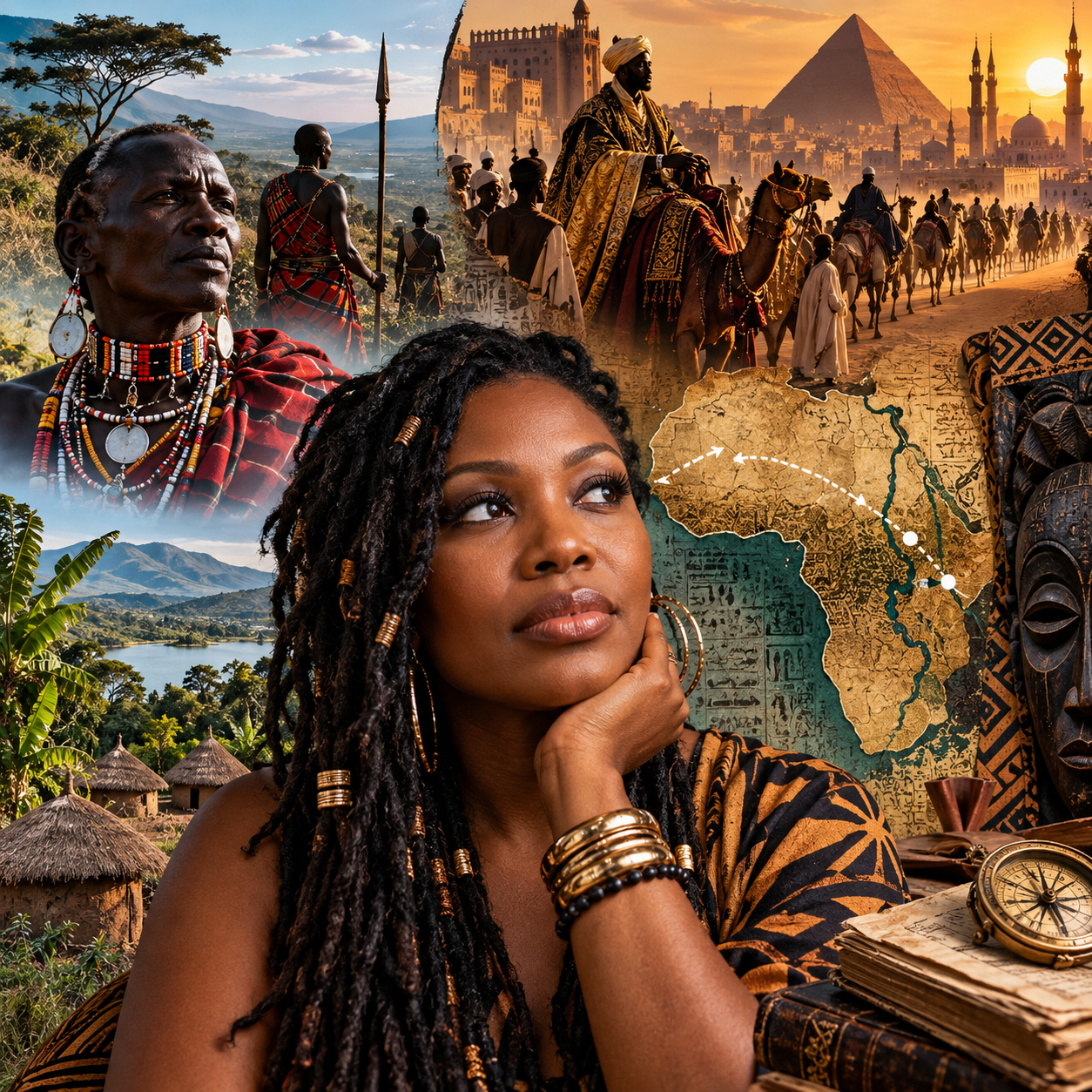
A Kenyan man came into my TikTok Live and told me my name sounded Teso.
I had never heard of the Teso.
A few hours later, I had pages of notes.
His name was Ekakoro. He was from Kenya, he was Iteso, and somewhere in what began as an ordinary TikTok conversation, he started teaching me words in Ateso, telling me about his culture and pointing out similarities he believed existed between his language and words and names I recognised from other parts of Africa.
Then he told me his theory about why.
It involved Mansa Musa, medieval Mali, Egypt, Sudan, the Nile and generations of African migration.
I didn’t know whether he was right.
But I knew I wanted to investigate.
That is, after all, what I seem to do.
I follow questions wherever they lead.
Why did my name sound Teso?
My name wasn’t given to me by my parents.
I chose African names later in my life as part of my own relationship with identity, ancestry and reconnection. My parents were Caribbean — Jamaican and Trinidadian — and like many descendants of Africans in the Caribbean, I know that Africa is part of my ancestry without possessing a neat map showing precisely where every branch of that ancestry began.
Oya is a Yoruba name. So when a Kenyan man from an ethnic group I knew almost nothing about heard my name and apparently recognised something familiar in it, I was curious.
Ekakoro told me that many names he encounters from Ghana and Nigeria sound surprisingly familiar to him as an Ateso speaker.
That doesn’t establish a connection.
Languages contain coincidences. Similar sounds can develop independently. Words can travel between neighbouring populations. Languages borrow from one another. And human beings are exceptionally good at noticing patterns once we begin looking for them.
But a resemblance doesn’t have to prove something to make it interesting.
It can simply give us a question.
Why did these sounds seem familiar to him?
First, who are the Iteso?
The Iteso live primarily in Uganda and Kenya, and their language is Ateso.
This much was relatively straightforward to establish.
Academic linguistic research classifies Ateso within the Teso-Turkana subgroup of Eastern Nilotic languages. It is related to languages including Turkana and Ngakarimojong, and its linguistic history belongs to the much broader history of Nilotic-speaking populations in eastern and northeastern Africa.
That mattered because one part of what Ekakoro had told me was immediately supported: the Iteso really do belong to a linguistic family whose history extends far beyond the modern borders of Kenya and Uganda.
And borders matter here.
When we talk about African peoples today, it is very easy to imagine the modern countries first: Kenyan, Ugandan, Nigerian, Ghanaian, Sudanese.
But languages, families, cultures and migrations are considerably older than many of those borders.
The map came later. Languages, families, cultures and migrations are older than many of the borders through which we now describe them.
Then he started teaching me Ateso
This was probably the point at which the conversation became irresistible to me.
Ekakoro started explaining how words worked.
One of the words he taught me was aberu: woman.
When I later went looking, there it was.
Ateso linguistic material independently records aberu as a word for woman, and academic work on the language confirmed something more interesting about what he had been trying to explain to me.
Those vowels at the beginnings of Ateso nouns can matter.
Ateso uses noun prefixes in its system of grammatical gender and noun classification. Linguistic descriptions document distinctions involving initial vowels, including masculine and feminine marking, rather than those vowels simply being meaningless sounds attached to otherwise identical words.
Ekakoro had given me examples of changing those initial vowels to communicate things such as gender, size or abundance.
The underlying grammatical phenomenon was real.
But the precise examples became more complicated when I tried to verify every one of them.
And I liked that.
Because there is a difference between saying:
This is what an Ateso man taught me about his language.
and saying:
This is linguistically established to work exactly as I have described it.
Those aren’t necessarily the same claim.
Some things I could verify. Some I couldn’t. Some appeared considerably more complicated once I began reading linguistic research.
Instead of ruining the investigation, that made it more interesting.
Even his name gave me another clue
Ekakoro had told me that his Teso name referred to a rooster.
For him, the rooster carried associations of bravery and leadership.
At first, I simply wrote it down as something he had told me about his name.
Then I went looking.
And Ateso material contains closely related forms for cock or rooster.
Suddenly another small piece of our conversation had acquired independent support.
Again, this proves nothing about some enormous forgotten migration across Africa.
But this was becoming my favourite part of the investigation.
Ekakoro would tell me something.
I would write it down.
Then I would go looking.
Sometimes I found exactly what I expected.
Sometimes I found something adjacent to it.
Sometimes I found something that complicated it completely.
Then came Mansa Musa
Eventually Ekakoro gave me his larger explanation.
His theory was that some of the apparent similarities he notices between Ateso and West African names or words might be remnants of historical African migrations.
And this is where Mansa Musa entered the conversation.
Mansa Musa was the fourteenth-century ruler of the Mali Empire whose pilgrimage to Mecca has become one of the most famous journeys in African history.
The pilgrimage itself is not legend.
Mansa Musa travelled through Cairo in 1324 on his way to Mecca, accompanied by a substantial entourage. Contemporary and later accounts differ about its precise size, but his extraordinary procession and expenditure in Cairo were recorded by medieval writers. Modern historical scholarship dates the pilgrimage to 1324–1325.
Ekakoro wondered whether people associated with movements such as this could have remained in northeastern Africa, mixed with other African populations and eventually contributed to migrations farther along the Nile and into eastern Africa.
It is a fascinating story.
But fascinating stories and established history are not the same thing.
This is where the theory begins to struggle
I went looking for the bridge.
Mali.
Mansa Musa.
Egypt.
Movement along the Nile.
Sudan.
The ancestors of the Iteso.
So far, I haven’t found credible historical or linguistic evidence establishing that chain.
What I found instead was a considerably older and more complicated story.
Ateso is not classified as an offshoot of a medieval West African language. It belongs firmly within Eastern Nilotic and specifically the Teso-Turkana group. Linguistic research reconstructing these relationships places them within a much deeper East and Northeast African linguistic history.
Recent archaeological research is particularly interesting here. Work examining population movements in eastern Africa discusses north-to-south expansion associated with Eastern Nilotic populations and evidence of Sudan-related ancestry in ancient East African populations dating to long before Mansa Musa’s fourteenth-century pilgrimage.
So Ekakoro may have been pointing toward something real in a broad sense — historical movement between northeastern and eastern Africa — while the particular Mansa Musa explanation may be attempting to connect events that belong to very different historical processes.
That distinction matters.
There is a huge difference between saying:
African populations moved over enormous distances, mixed, separated and formed new communities.
and saying:
These particular people descended from members of Mansa Musa’s entourage.
The first is unremarkable as a general feature of human history.
The second requires evidence.
And I haven’t found it.
But then what about the similarities?
This is where I refuse to replace one premature conclusion with another.
If two words in distant African languages sound similar, there are several possibilities.
They could ultimately share an ancient linguistic ancestor.
One language could have borrowed something from another.
Populations could have interacted at some point.
Or two words could simply sound alike by chance.
Comparative linguistics doesn’t establish relationships by finding one or two words that resemble each other. Researchers look for systematic patterns across substantial bodies of vocabulary, grammar and sound change.
So hearing an Ateso word that sounds like something from Ghana or Nigeria isn’t enough to redraw African history.
But neither do I think the appropriate response is: That’s a coincidence. Next question.
I want to know which language the supposedly similar West African word comes from.
I want to know how old both forms are.
I want to know whether there are ten similarities or one.
I want to know whether the consonants change systematically.
I want to know what historical movements are independently supported.
In other words, I don’t want the resemblance to become evidence before it has earned that status.
But I also don’t want curiosity killed simply because evidence hasn’t arrived yet.
There is another kind of evidence too
Something else happened during that conversation.
Ekakoro wasn’t giving me an academic lecture.
He was telling me what he had been told.
What he remembered.
How his people understood certain practices.
What words meant to him.
Where he believed his ancestors had travelled.
And that raised another question for me.
What do we do with oral knowledge?
Oral history is not automatically factual simply because it has been transmitted across generations.
But written history isn’t magically free from perspective either.
Colonial archives were produced by particular people for particular purposes. Missionaries documented some African traditions while actively attempting to transform others. Anthropologists interpreted cultures through their own frameworks. Indigenous histories sometimes survived precisely because people continued telling stories that were never written down.
So perhaps the task isn’t to choose between:
The academic source is true.
and
The elder’s story is true.
Perhaps the more interesting work begins when we place different forms of knowledge beside one another and ask what each can actually establish.
Africa contains histories we may no longer know how to read
That thought stayed with me after the Live ended.
A word can survive after its history has been forgotten.
A ritual can survive after its explanation changes.
A name can cross generations after nobody remembers why the first person carried it.
A migration can remain inside an origin story long after dates and locations become blurred.
And sometimes entirely unrelated things can resemble one another so strongly that human beings construct a connection that never existed.
All of these things can be true.
Which makes reconstructing African history particularly fascinating.
The continent has experienced migrations, empires, trade, intermarriage, religious conversion, colonial borders, language suppression and enormous cultural change.
Some connections will be recoverable.
Some will turn out to be imagined.
Some may remain permanently uncertain.
I still don’t know why my name sounded Teso
And perhaps that’s the most appropriate ending.
I started with a remarkably simple moment.
A Kenyan man heard my name and said:
That sounds like us.
From there came Ateso grammar, Nilotic migrations, Mansa Musa, medieval Cairo, oral history, comparative linguistics and questions about what happens to human memory across generations.
I haven’t discovered that my name is secretly Teso.
I haven’t discovered that the Iteso descended from Mansa Musa’s entourage.
I haven’t uncovered a forgotten migration connecting Nigeria, Ghana and Kenya.
What I discovered was a question.
And perhaps that is enough.
Because curiosity doesn’t require us to believe every explanation we encounter.
It requires almost the opposite.
To listen seriously.
To investigate carefully.
To be willing to discover that something we hoped was true isn’t.
To be equally willing to discover that something we dismissed contains a fragment worth following.
A similarity is not proof of a connection.
But sometimes a similarity is enough to give you a question worth following.
And I intend to follow this one a little further.
OBSERVE · QUESTION · EXPLORE · CREATE
Leave a Reply