CONSCIOUSNESS · ARCHIVE 004
What Philosophy Was I Living Before I Knew Its Name?
A conversation about existentialism and postmodernism became a much stranger question: can we live a philosophy before we know its name?
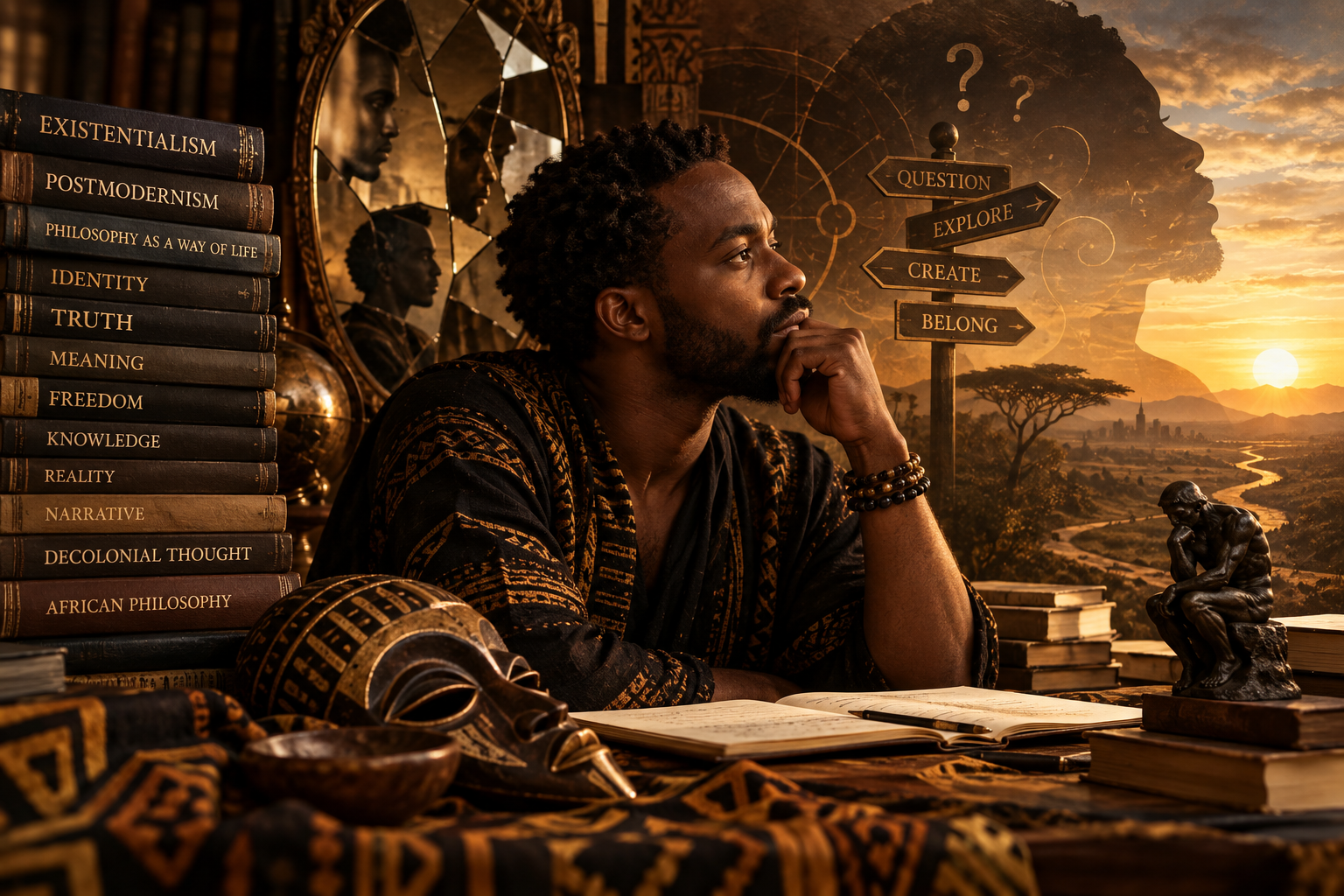
A Kenyan man I met on TikTok told me I was a postmodernist-existentialist.
There was only one problem.
I didn’t know what a postmodernist-existentialist was.
We had spent hours talking by then. His name is Ekakoro, and our conversations have a habit of beginning somewhere ordinary and wandering somewhere neither of us particularly planned.
We had talked about language. African history. Christianity. Culture. AI. Hypnosis. Truth. Whether a glass containing exactly half its capacity of water was half full or half empty.
Then one day he asked me what kind of music I listened to “as a postmodernist thinker.”
I stopped.
As a what?
When I asked him why he thought I was a postmodernist, his answer wasn’t particularly helpful.
We had spoken at length, he said. I was a “postmodernist-existentialist.”
So naturally, I asked him for evidence.
His response, essentially, was that I should look at the philosophies and then look at my own writing.
Res ipsa loquitur.
The thing speaks for itself.
Apparently, I had been writing philosophy without knowing what philosophy I was writing.
Can we live a philosophy before we know its name?
Apparently I have been doing philosophy accidentally
Ekakoro said something during our conversation that stayed with me.
“Philosophy is a lived experience.”
His argument was that everything we think, say and do is influenced by some philosophy whether or not we recognise it. Scholars, in his view, didn’t necessarily create these ways of thinking. They identified them and gave them names.
I wasn’t completely convinced.
It sounded plausible. But plenty of things sound plausible until you investigate them.
So I went looking.
And, annoyingly, Professor Ekakoro—who insists he is not a professor—had stumbled into a rather serious philosophical tradition.
Existentialism in particular is not simply an abstract system constructed in universities. It places unusual emphasis on concrete, first-person existence: what it actually feels like to find ourselves alive, situated in particular circumstances and required to make something of that life.
Perhaps more surprisingly, even the category existentialist is something of a retrospective construction.
Thinkers now routinely grouped under existentialism disagreed enormously. Some were religious. Others weren’t. Some emphasised radical freedom while others placed far greater emphasis on circumstance and limitation. Several major figures now associated with the movement did not comfortably accept the label themselves.
So perhaps the labels really do sometimes arrive after the thinking.
That made Ekakoro’s accusation considerably more interesting.
So what did he recognise in me?
Existentialism was the easier half.
One of its recurring ideas is that a human being is not simply born as a completed thing.
We become.
Sartre famously expressed this as “existence precedes essence.” The basic idea is that there isn’t necessarily a finished definition of you waiting inside you to be discovered. We participate in creating ourselves through our choices, actions, commitments and interpretations of the circumstances into which we have been thrown.
That felt familiar.
I have spent years questioning identities I inherited.
Names.
Religion.
Mental health labels.
Ideas about success.
Ideas about spirituality.
Ideas about what a woman should be.
Ideas about what a mother should be.
Ideas about what sanity means.
Ideas about who gets to tell another human being what their experiences mean.
Even the name under which I am writing this wasn’t simply handed to me and unquestioningly carried forward.
Osose is part of something I participated in becoming.
Perhaps that is one reason Ekakoro heard existentialism in my writing.
But existentialism also contains a tension I recognise deeply.
We don’t create ourselves from nothing.
I did not choose where I was born. I didn’t choose my ancestry. I didn’t choose my childhood. I didn’t choose every event that happened to me. I didn’t invent the culture or language through which I first learned to understand myself.
Yet none of those things completely determines what I must become.
Existentialist thinkers wrestled repeatedly with this tension between the circumstances we inherit and what we do with them.
And suddenly I could see why Ekakoro had reached for the word.
Postmodernism was harder
This was where I resisted him.
Because when I vaguely thought of postmodernism, I associated it with an idea something like:
There is no objective truth. Everything is interpretation.
And that doesn’t describe me particularly well.
I question things constantly.
But I don’t necessarily question them because I believe nothing is true.
Quite often, I am questioning precisely because I think something may be true underneath what I have been told.
That distinction matters to me.
If somebody tells me that a particular African spiritual figure is evil, I want to know who first described it that way.
If a historical source calls an indigenous practice primitive, I want to know who wrote the source.
If somebody tells me that science has proven something, I want to know what the experiment actually demonstrated.
If somebody makes a spiritual claim, I want to know whether they are describing an experience, an interpretation, a metaphor or an empirically testable claim.
I am not trying to make truth disappear.
I am trying to remove the things that may be obscuring it.
So perhaps Ekakoro was wrong.
Except postmodernism turned out to be more complicated than the version I had been arguing against.
Postmodernism doesn’t simply mean “nothing is true”
The term itself covers a messy collection of thinkers and ideas rather than one unified doctrine.
One influential formulation comes from Jean-François Lyotard, who characterised the postmodern condition through scepticism toward metanarratives: enormous explanatory stories that claim to organise history, knowledge or human progress into one overarching account.
Other thinkers commonly associated with postmodernism and post-structuralism examined how language, institutions, history and power influence the categories through which we understand reality.
Michel Foucault, for example, became interested in genealogy: examining how concepts and systems that can appear natural or inevitable actually developed through particular historical circumstances. Jacques Derrida interrogated assumptions embedded within language and texts. Neither man fits neatly inside a single philosophical box.
And that was when I became slightly uncomfortable.
Because I recognised the questions.
Who decided this?
When did we begin describing it this way?
What existed before this category?
Whose interpretation became authoritative?
What disappears when one explanation becomes the official explanation?
Those are questions I ask constantly.
I had just written an entire investigation after a Kenyan man told me that my name sounded Teso.
Before that, I had been investigating what happens when ancestral knowledge isn’t transmitted.
Before that, I had been asking questions about belief, consciousness, identity and the meanings human beings inherit.
Perhaps Ekakoro had noticed the method before I had noticed it myself.
But I still don’t think the label completely fits
And this may be the most important part.
Because after telling me what philosophy I apparently belonged to, Ekakoro himself refused to assign a philosophical worldview to himself.
I asked him which worldview prevailed in his thinking.
He asked:
Regarding what?
His argument was that it would be unreliable for him to assign himself a worldview because he might simply choose whichever description made him appear most desirable. Other people, he suggested, could observe him and decide where they thought he belonged.
That irritated the part of me that wanted a clean answer.
But perhaps he was demonstrating his own argument.
People don’t necessarily live inside philosophical boxes.
We can be sceptical in one context and deeply believing in another.
We can demand empirical evidence for one claim and trust lived experience for another.
We can believe objective reality exists while recognising that human beings encounter that reality through subjective perception.
Which brought us to a glass of water.
Half full or half empty?
Ekakoro gave me the familiar thought experiment.
A glass is filled halfway.
Is it half full or half empty?
I refused the premise almost immediately.
I wanted to know what the water was for.
If a recipe required exactly that amount of water, I said, the glass was neither deficient nor abundant.
It contained exactly what was needed.
He accused me of taking an escapist approach.
So he removed my escape routes.
You walk into a room. There is a glass. It is filled halfway. Half full or half empty?
I still wanted context.
If I had been walking through a desert without water and suddenly discovered that glass, I might experience it as astonishing abundance.
If I needed enough water to shower and there was no other water available, the same quantity could feel radically insufficient.
Ekakoro then pointed out that those internal and external circumstances were precisely what shape perception.
And suddenly we were no longer discussing optimism.
We were discussing reality.
The quantity of water is measurable.
150 millilitres can simply be 150 millilitres.
But enough, scarce, plenty, fortunate, disappointing and valuable are not properties floating inside the water.
They emerge through a relationship between the water, the environment, the observer and what the observer needs.
Then we disagreed again.
Ekakoro thought a very thirsty person with no other available water might be more inclined to see the glass as half empty.
I thought the opposite was equally plausible.
After hours without water, I might look at that glass and think:
Water.
Two people can therefore encounter the same objective quantity under remarkably similar circumstances and still experience its meaning differently.
The water doesn’t have to become unreal for interpretation to become important.
That distinction may explain my discomfort with the postmodernist label better than anything else.
I don’t want to choose between reality and interpretation
There seems to be a temptation in intellectual arguments to force us toward one side.
Either there is objective reality and subjective interpretation is merely distortion.
Or everything is interpretation and claims to objectivity are themselves constructions.
I don’t find either position particularly satisfying.
Perhaps there is a world that exists independently of me.
And perhaps I never encounter that world without also being me.
I bring a body.
A history.
Language.
Expectations.
Fear.
Memory.
Culture.
Desire.
Previous experiences.
And questions.
That doesn’t necessarily make reality subjective. It makes my encounter with reality situated.
Interestingly, existentialism itself strongly emphasises this situated quality of human experience. Its thinkers generally reject the fantasy that we can understand human existence entirely from some detached “view from nowhere.” We encounter existence from inside it.
And the intellectual traditions that followed existentialism—including post-structuralism—pushed some of those questions further, examining how history, language and social structures shape the subjects doing the interpreting.
Perhaps that is why Ekakoro used both words.
Not postmodernist.
Not existentialist.
Postmodernist-existentialist.
Perhaps philosophies overlap because people do
There is something strange about discovering a thinker from another century articulating something you thought you had arrived at yourself.
Did I independently discover existentialism?
Obviously not in any meaningful historical sense.
Millions of people have encountered these ideas before me.
And the language through which I think has itself been shaped by centuries of ideas I may have absorbed indirectly without ever reading their originators.
Perhaps I encountered existentialist ideas through novels.
Therapy.
Spiritual writing.
Films.
Conversations.
Culture.
Perhaps ideas travelled into my thinking without their labels attached.
Or perhaps human beings repeatedly arrive at similar questions because we repeatedly encounter the same fundamental problem:
We wake up inside lives we did not design and have to decide what to do with them.
Philosophers then become unusually persistent people who refuse to stop asking what that means.
Did philosophers invent philosophy?
I don’t think I would now state Ekakoro’s proposition quite as strongly as he did.
Scholars don’t merely walk around discovering fully formed philosophies lying inside ordinary human behaviour and attaching labels to them.
Philosophers construct arguments.
They create concepts.
They disagree.
They refine distinctions.
They inherit earlier ideas and transform them.
Sometimes an individual thinker genuinely changes the intellectual possibilities available to everyone who comes afterwards.
But I think Ekakoro was pointing toward something important.
Philosophy doesn’t begin when somebody opens a philosophy book.
A person wondering whether they are obligated to obey the religion of their parents is already confronting questions about authority, freedom and identity.
Someone deciding whether suffering has meaning is doing something philosophers have spent millennia doing.
Someone asking whether the person they became was chosen or conditioned has wandered into debates about freedom and determinism.
Someone asking whether something can be true even if nobody believes it exists has entered epistemology and metaphysics whether or not they know either word.
The academic discipline gives us histories, concepts, distinctions and conversations extending across generations.
But the questions themselves belong to human beings.
And perhaps the labels should come last
There is something wonderfully ironic about this investigation.
I began by asking whether I was really a postmodernist-existentialist.
I ended by becoming less interested in knowing.
Perhaps philosophical labels are maps.
Maps are useful.
They show us where ideas have travelled before.
They allow us to recognise intellectual neighbours we didn’t know we had.
They give us language for distinctions we were struggling to articulate.
But nobody lives inside a map.
And I don’t particularly want to start filtering my thoughts through a new question:
What would an existentialist think about this?
That would reverse the entire process.
I would rather encounter the question first.
Think.
Get something wrong.
Change my mind.
Contradict myself.
Follow the contradiction.
And only afterwards discover whether somebody else has been standing somewhere nearby for the last two thousand years.
Maybe Ekakoro was right.
Maybe philosophy was already present in my writing before I knew what anybody would call it.
But perhaps the discovery isn’t:
I am a postmodernist-existentialist.
Perhaps it is something much more interesting.
There are names for some of the questions I have been asking.
And now I have more people to ask them with.
Sources & further reading
- Stanford Encyclopedia of Philosophy — Existentialism
- Internet Encyclopedia of Philosophy — Existentialism
- Stanford Encyclopedia of Philosophy — Postmodernism
- Internet Encyclopedia of Philosophy — Postmodernism
OBSERVE · QUESTION · EXPLORE · CREATE
Leave a Reply