CONSCIOUSNESS · ARCHIVE 002
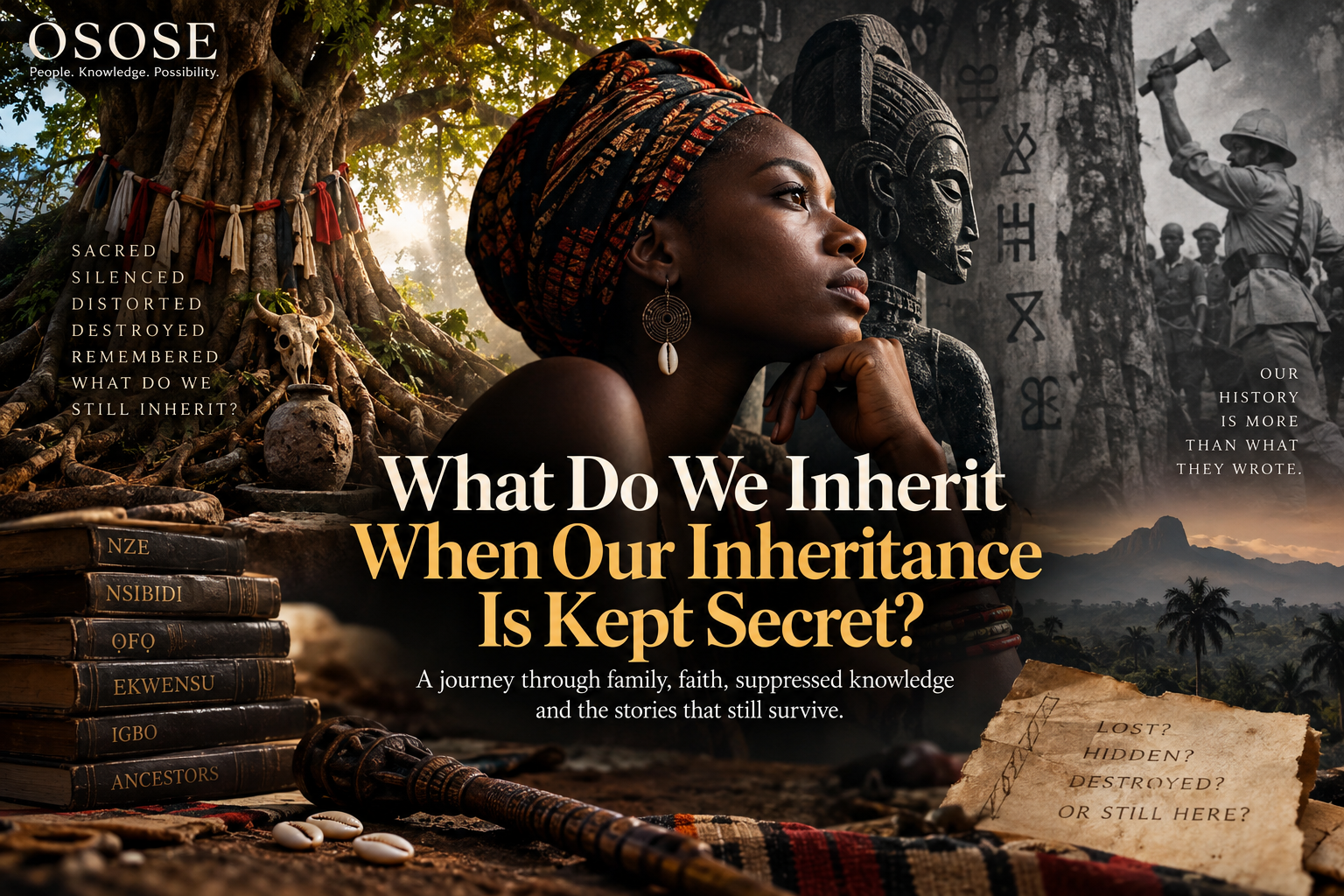
What Do We Inherit When Our Inheritance Is Kept Secret?
An investigation into ancestral knowledge, interrupted transmission, Christianity, secrecy and what it means to inherit a past you were never taught.
I met Patrick Igweh on a TikTok Live.
I hadn’t gone there looking for an investigation into ancestral knowledge. I wasn’t researching Igbo religion or colonial history. We were simply talking, and as conversations sometimes do, this one kept opening doors.
Patrick is Nigerian and Igbo. At some point, he told me that his great-grandfather had been an Nze—a man he described as a custodian of law, someone whose position carried not only social authority but spiritual backing.
I later discovered that this description wasn’t entirely unfamiliar to the historical record. Nze/Ozo institutions varied considerably between Igbo communities, but title-holders could occupy positions carrying religious, political, ethical and social significance. That doesn’t tell me precisely what Patrick’s great-grandfather did. It does tell me that the world Patrick was describing had institutional roots deeper than a family story.
And then he told me something that stayed with me.
None of the children continued it. The line ended.
At first, I heard this as a story about something being lost. But the longer we spoke, the less certain I became that lost was the right word.
Because there are many ways for knowledge to disappear. It can be forgotten. It can be destroyed. It can be deliberately abandoned. It can become incompatible with a new religion. It can survive in one branch of a family while disappearing from another.
And sometimes it doesn’t disappear at all.
Sometimes people simply stop telling you.
When nobody tells the children
Patrick grew up in a Christian family. His great-grandfather belonged to a world that Patrick did not inherit in the same way.
When I asked about that world, his attitude was initially almost startlingly matter-of-fact. His great-grandfather had lived his life. His father had lived his. Patrick was living his own.
There was something in that I understood. We talk about ancestry as though inheritance automatically creates obligation. But why should someone be required to continue a spiritual practice simply because their ancestors practised it?
Perhaps refusing an inheritance is itself an expression of sovereignty.
Yet later in our conversation, Patrick described Igbo identity very differently. He spoke about family responsibility—about the person who travels abroad carrying brothers, sisters, nephews and nieces with them. The individual, in his description, does not exist entirely alone.
Where does the individual end and the ancestors begin?
I don’t think the answer is that we owe our ancestors obedience. But perhaps there is a difference between choosing not to carry something and never being told what there was to carry.
Lost is not the same as hidden
Patrick kept returning to the idea that people know more than they admit. At one point he told me, you have to go deep to understand.
Then he told me a story from his own family.
What follows is Patrick’s account as he told it to me. I have not independently verified the events.
There had been a tree associated with older spiritual practices. During a Christian prayer session, a priest identified the tree as evil. Patrick’s uncle was there, but according to Patrick, his uncle behaved as though he didn’t know what the tree was or what had previously happened there.
Later, Patrick learned a very different history of the tree. He told me that it had once been a place where sacrifices were made. Animals had been sacrificed there and, according to the account passed down to him, human beings had also been sacrificed there.
The sacrifices had stopped.
Patrick’s story then became stranger. He said the spirit associated with the tree became angry because it was no longer receiving sacrifices. Somehow, the tree was moved from its original location and appeared in another village. A baby subsequently died there. The people in that village interpreted the death as connected to the tree and the spirit associated with it. They investigated where the tree had come from, traced it back to Patrick’s community and returned it. Eventually, according to Patrick, the tree was removed again and dumped beside a highway.
It is an extraordinary story. And there are several completely different claims contained inside it: the possible history of the physical tree and where it was moved; the oral history that animal and human sacrifices had once taken place there; the Christian priest’s interpretation of the tree as evil; the older spiritual interpretation that the tree was associated with a spirit requiring sacrifice; the baby’s death; and the causal interpretation that the spirit caused that death because the sacrifices had stopped.
I don’t know which of those events could be independently established. A baby dying after the arrival of a tree does not, by itself, establish that a spirit killed the child. Equally, dismissing the entire account as superstition would tell me very little about what the tree meant to the people who lived with it.
But strangely, the supernatural part wasn’t what interested me most.
It was Patrick’s uncle. Why pretend not to know?
Here was a Christian priest identifying something as evil while a member of the family, according to Patrick, possessed an older understanding of exactly what that thing was—and remained silent.
Perhaps somebody remembered. Perhaps they had rejected it. Perhaps Christianity had made acknowledging that knowledge uncomfortable. Perhaps there were things the older generation simply did not want to explain to the younger one. Or perhaps Patrick’s interpretation of his uncle’s silence is itself part of a story reconstructed later.
I cannot know.
What looks like forgetting from the outside but is actually silence?
There is a difference between knowledge being lost, forgotten, rejected, concealed and deliberately not transmitted. Those categories can look identical several generations later.
The grandchild simply doesn’t know.
Some knowledge was never meant for everybody
It would be easy to construct a familiar story: Africans possessed ancestral knowledge; Europeans arrived; Christianity displaced indigenous traditions; the knowledge disappeared.
There is truth inside parts of that history. But the neatness of the story bothered me. Because when I began researching the traditions Patrick had mentioned, I encountered something that complicated it.
Some knowledge was already restricted.
Nsibidi, for example—the graphic communication system Patrick mentioned during our conversation—was used historically across communities in southeastern Nigeria and the Cross River region. Some signs could circulate more publicly while other bodies of signs were associated with initiated societies and restricted knowledge.
Secrecy, therefore, cannot simply be interpreted as evidence of colonial erasure. Sometimes secrecy was part of the knowledge system itself.
If knowledge belongs only to particular initiates, elders, title-holders or ritual specialists, what happens when the chain of initiation breaks?
The symbols may remain. The objects may remain. Someone may even remember fragments of what they mean. But access to the system that made those fragments intelligible can disappear.
There is a difference between losing knowledge and losing access to knowledge.
Truth you can hold in your hand
One of the things Patrick described to me was ọfọ. He told me it represented truth.
In his account, spiritual authority wasn’t simply power. A person had to be morally capable of carrying it. Someone whose hands were metaphorically stained could not simply pick up such authority and use it without consequence.
When I later looked for scholarship on ọfọ, Patrick’s description suddenly became much less unfamiliar. Research describes it as a material and mystical symbol connected with truth, purity, justice and authority, and connects ọfọ-na-ogu with innocence, uprightness and moral purity.
That doesn’t establish Patrick’s supernatural claim about what happens to someone who uses it wrongly. But the moral architecture he described—the idea that legitimate authority and moral standing belong together—is documented.
And that made another phrase Patrick used stay with me.
He spoke about a time “when the rituals got soured.”
His interpretation was that practices originally connected with protection, truth and obligation became corrupted by the desire for money and power.
I don’t yet know how much of that chronology can be historically demonstrated. Oral histories are not automatically factual simply because they are ancestral, just as colonial records are not automatically neutral simply because somebody wrote them down.
What happens when a spiritual technology survives but the ethical system that governed it doesn’t?
What survives attempted destruction?
Patrick had told me that Europeans had “taken” or destroyed some of the older oracles. That claim sounded enormous until I encountered the history of Ibinukpabi, the Aro oracle British sources called the Long Juju.
A British military expedition destroyed the shrine in 1902. Historical research records that it was secretly restored, destroyed again and restored again, while colonial authorities curtailed powers exercised by important shrines that conflicted with the new colonial government.
This doesn’t turn Patrick’s broad statement into a description of every oracle or every Igbo community. But it gives us a documented example of deliberate institutional disruption—and of people refusing to let an institution simply disappear.
What do we call knowledge that survives its own attempted destruction?
When a warrior becomes the Devil
Then Patrick told me about Ekwensu.
Patrick explained that when Christians spoke about the Devil in Igbo, they used the name Ekwensu. But the Ekwensu he had learned about from older Igbo tradition was not simply another name for the Christian Devil. He described Ekwensu as a powerful warrior figure associated with Igbo strength and resistance. That distinction caught my attention: had an existing Igbo spiritual figure been made to carry the meaning of a very different Christian being? When I went looking for the history behind what Patrick had told me, I discovered that the question had a documented history of its own.
Nigerian scholarship describes Ekwensu as a heroic Igbo deity of war and patron spirit of ancient Igbo warriors, while more recent ethnographic research describes a divinity associated with warfare and fertility whose characteristics differ substantially from the Christian Satan.
That means something important really did happen through translation.
A name remained. But what the name pointed to changed.
Patrick’s story, however, contained another layer. He had been told that Ekwensu was himself a powerful human warrior who fought Western conquerors, and that his name was subsequently demonised because of his resistance.
That is where the written evidence becomes much thinner.
I can find evidence for Ekwensu as a war divinity. I can find evidence for warriors invoking Ekwensu. I can find scholarship challenging the later equation of Ekwensu with Satan. What I cannot yet establish is that Ekwensu began as a historical human warrior whose identity was deliberately erased by Europeans.
And perhaps the space between those versions is itself part of the inheritance.
How does a war god become the Devil? How does a spirit associated with warriors become remembered as a warrior? And after generations of translation, conversion and oral retelling, how do we know which transformation happened when?
I don’t want to solve that uncertainty by simply choosing whichever version appeals to me more. If I am interested in recovering knowledge that may have been distorted, I cannot respond by accepting every counter-story simply because it feels more restorative.
Otherwise I have only exchanged one unquestioned narrative for another.
What happens when a worldview disappears?
An object can survive longer than its meaning. A word can survive after the concept it once carried has changed. A ritual can continue after people have forgotten why particular movements are performed. A sacred object can enter a museum and become art. A deity can become a devil. A family can remember that a great-grandfather held an important title without remembering what he knew.
And a descendant can eventually type the remaining fragments into Google.
Patrick himself told me that some of what he now knows about older traditions did not come through his own family. Someone else told him things they had learned through their grandparents. Patrick then searched online.
Grandparent → grandchild → stranger → Google → Patrick → TikTok Live → me → this page.
Perhaps that is also transmission. Not the transmission the original holders would have recognised, but transmission nonetheless.
And it makes me wonder how many fragments of human knowledge are currently travelling through pathways like this.
Not preserved intact. Not completely lost. Just wandering.
The archive is not neutral
At one point during our conversation, I became suspicious of Google itself.
If I search for African traditions using a search engine built within a Western technological system, whose version of Africa am I actually retrieving?
But that question also needs complication. The problem isn’t simply that “Western people wrote the history.” The deeper problem is what becomes searchable.
Who wrote things down? Who had access to printing? Which manuscripts survived? Which languages were digitised? Who catalogued museum collections? Which oral traditions were recorded before their holders died? Which accounts were written by missionaries describing practices they already considered pagan? Which were written by colonial administrators trying to govern people they didn’t fully understand? Which modern accounts are descendants reconstructing from fragments?
And what happens to knowledge that never entered an archive at all?
Google can retrieve a colonial officer’s description written a century ago. It cannot retrieve the conversation a grandmother never had with her granddaughter.
That absence matters. But absence is not evidence that whatever we imagine was there must have existed either.
The archive can be incomplete without our imagination automatically becoming the missing page.
Recovery is not restoration
There is another danger in conversations about ancestral knowledge.
Romanticism.
Old does not automatically mean wise. Indigenous does not automatically mean good. Ancestral does not automatically mean something I am morally required to reproduce.
Patrick himself talked about practices he would not want to continue. We discussed sacrifice, spiritual power and traditions that later generations may have rejected for reasons entirely their own.
Remembering something is not the same as endorsing it.
I can understand why an ancestor performed a ritual without performing it myself. Someone can learn the name of a deity without worshipping that deity. A Christian can investigate the religion of their ancestors without ceasing to be Christian. A descendant can decide that an ancestral practice was cruel. Another can decide that something precious was discarded unnecessarily.
Both decisions become more meaningful when they are made with knowledge.
Perhaps recovery is not about returning to the past. Perhaps it is about recovering enough of the past to choose our relationship with it consciously.
What did I inherit without knowing it?
And somewhere during this conversation, Patrick’s story stopped being entirely about Patrick.
I chose the name Oya Omore as part of my own process of identity and sovereignty.
Now I find myself researching what Omore actually means.
Not what a baby-name website tells me it means. Not what I would like it to mean. I want to follow the word backwards—through dictionaries, languages, spellings, missing tonal marks, geography and history—and see what survives.
That investigation has already produced another cupboard full of questions.
And perhaps that is why Patrick’s story affected me. I am also trying to understand what I inherited.
Some of that inheritance is biological. Some cultural. Some spiritual. Some imposed. Some chosen. Some may be imagined. And some may be impossible to recover.
Self-discovery, then, is not simply asking Who am I?
Who was I told I was? Who were the people before me? Who named them? What did they stop saying? What did somebody else rename? What survived anyway?
And perhaps most importantly:
If I recover something that was not given to me, what do I do with it now?
I don’t think inheritance demands obedience. But I am beginning to think there is a particular kind of loss in being unable to choose because nobody ever told you what the choices were.
Patrick Igweh’s great-grandfather had knowledge Patrick did not inherit.
Yet generations later, sitting on opposite sides of the world, two strangers began talking about it on TikTok.
And now I am looking for it too.
Maybe some knowledge doesn’t disappear.
Maybe it just waits for somebody to ask the next question.
Sources & further reading
- Ajaebili, Eze & Omeje — research on Ọfọ as Igbo tangible and intangible heritage
- Stephen Ellis — “The Okija Shrine: Death and Life in Nigerian Politics,” Journal of African History
- Journal of Religion in Africa — research on Ekwensu and the Christian Satan
- Okpalike & Chukwu — “Ekwensu Deity and the Paradox of the Christian Devil”
- The Metropolitan Museum of Art — Cross River graphic traditions and restricted knowledge
- Toyin Falola — oral traditions and indigenous knowledge production in Nigeria
OBSERVE · QUESTION · EXPLORE · CREATE
Leave a Reply